skip to main |
skip to sidebar
Hours of fun....
Here is your Grid:
 It is divided into two smaller internal four-square grids with an addititonal four-square row along the side and three squares left over along the bottom.
The game is to create a four-year rotation cycle using this grid, four times (one for each year).
Each square must be filled with your choice of vegetable crop from one of the five groups listed below, according to the following rules:
1)No square should contain the same crop as the one next to it.
2) You do not have to use all the individual crops suggested, and may if you wish, use some of them more than once - but there should be no more than two individual squares of the same crop in the whole grid.
3) To ensure healthy plants and good yields, these crops should rotate over the four years through the smaller internal grids/rows in the following order:
a) Nightshade Family
b) Pea Family
c) Brassica Family
d) Roots/Alliums
*If the crop you start with in Year 1 is from Group c) on the list, then your Year 2 crop will be from Group d), then it's back to the top so that your Year 3 crop is from Group a) and so on.
4) The following should not be planted in adjacent squares, as proximity may damage the yield of one or both crops:Peas and Alliums
5) You may at any point choose to play a "Joker" by filling a square with one of the suggested salad crops, as these may be safely placed anywhere in the rotation scheme. There is no limit on the number of jokers you may play. Just bear in mind that there is only so much lettuce a normal human being can eat in one summer.
Nightshade family
Potatoes
Chillies
Cherry Tomatoes
Roots and Alliums Parsnips
Carrots
Garlic
Onions
Brassica familyBrussels SproutsPak Choi
Sprouting BroccoliPea Family
Mange Tout
Sugar Snaps
SaladsLettuce
Rocket
Spinach beet
Chard
Tip: Try to account for the expected height of your selected plants, the amount of shade they will create on the squares around them, and which of your other crops will need lots of sunlight.
Enjoy!
So I know two things about summertime flowers. I know what I would like, and I know what I absolutely do not want to end up with.
I would like to fill the edges of the lawn with lots of bright, cheery things like poppies and cornflowers and big, happy ox-eye daisies and lupins - I love lupins! I remember them all around the sides of the field behind my grandparent's garden, they come out in high summer in lots of bright colours like so many roman candles... and they'd be tall enough to hide the fences. 

Ideally, these would be followed in September and October by lots of fiery reds, yellows and oranges in the same spots - dahlias and rudbeckias would be perfect.  Unfortunately, most of these plants like lots and lots of sunlight. This is why they grow in cornfields and not in woods. Now, our back fence gets lots of sunlight, but first of all, this is where the trench around the lawn is deepest, so the small seedlings would probably get shaded out. I will also need most of this space for raspberry canes, as it is where the fruit has the best chance of ripening properly. The trench along the side of the lawn is the bit of the garden which gets the least sunlight, because of the shade from the fence - so it's no go there either. I know from the old place that dahlias and rudbekias do really, really badly in shade. Cornflowers might just about work, and ox-eye daisies seem happy enough in the shady gardens of the surrounding streets.
 So began a process of research on plants for shady gardens. This was initially depressing, as it seemed to involve the very set of boring non-native pretentious-colonial-botanist's-collection stuff I associate with the dank, gloomy, formal gardens of dank, gloomy, formal mock-gothic mansions. What was it with the late Victorians? All death and respectability, no fun.
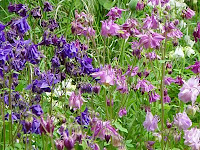 I cheered up a bit after flicking through a pocket paperback on shade plants in the library. It seems most of the summer plants I want to put in the bed under the roses will tolerate partial shade, so I'll fill it with columbines, London Pride and stocks (for scent). I also decided that I will only need about half of the trench along the back fence for raspberries - so the section up to the almond tree will be getting the cornfield treatment after all. Two metres of it will look a lot less dramatic than the whole garden edge, but hey, it's better than nothing. I still won't get dahlias, though.
So what can I do about that terminally shady right-hand trench?
I can use foxgloves instead of lupins, for a start. Bees and butterflies love foxgloves, so that's good. And they have the height to hide the fence. I'll experiment with some of the cornfield type flowers next year and see what happens. Perhaps if I put them in grow beds so that they are level with the lawn, they will get a bit more sunlight, I don't know (I can't just build up the soil to the right level, because it would get soggy, and probably rot the bottom of the fence).
 "Bleeding heart" is also apparently reasonably shade tolerant. I'd never heard of it before, but now that I have, I have to have one. Or maybe two, as there is also a white version - appropriate for the garden of a Spurs fan! I think they would grow high enough to give some good cover and colour in the back right-hand corner.
It's all still going to look a bit bare in the autumn, though. The obvious thing would be to go for a climber up the fence which would go bright red. The trouble is, most of them will only do that if they get sunlight. And I hate Virginia Creepers anyway. There's something about the way they spread all the way over walls and along the ground which gives off a 1950s sci-fi comic book vibe - like they want to take over the world while you're sleeping...
Spouse, incidentally, has expressed limited opinions on flowers ("daffodils are evil", and "Bluebells, please!).
I have two areas to put flowers in. One is the corner underneath the retaining wall and along the fence, where the pear tree and the roses are. The other is the sloping trench between the underpinned lawn and the right hand fence.
 English spring flowers are all about carpets of snowdrops, primroses, violets, anenomes, daffodils, bluebells... Thanks to a childhood of Sunday trips into Kent, and holidays with rural grandparents in Norfolk, I can pretty much recite the progression in my sleep. And they're all woodland plants, which is good, because in urban terms, we're in the woods.
  No daffodils, though :-( . Spouse regards daffodils as "evil flowers"! He's okay about narciscii, but I feel about them rather the way he feels about muscari (narciscii = fake daffodils, muscari - fake bluebells). Still, he's agreed that I can put some crocuses in the sunny right hand corner of the lawn, as they will have finished by the time he needs to start mowing it. A mix of these, with some snowdrops and the almond blossom, should give that corner a lovely cheerful start to the year, visible from our back windows.
 I will have to put wood anenomes, primroses and violets under the roses, because they grow low to the ground, so if they are planted in the trench, they will be lower than the side of the lawn and we won't really see them. Under the roses, they'll be hidden from the windows by the retaining wall, but at least we will see them when we are actually in
 the garden. I'll try chucking in some Snake's Head Fritillaries as well, because
  they're fun, and also - I could be wrong about this, but - I seem to remember them being endangered when I was a kid. I think bluebells should be tall enough to poke out over the top of the trench at the shallower end of it. All in all, February to May should be easy enough. Get bulbs, shove 'em in the ground, cover with netting to prevent the squirrels getting 'em - sorted.
It's the summer and autumn that get difficult.
Somehow I have a copy of the "Which? Guide to Vegetable Growing". I have no idea when or where I bought it, but I'm really glad I did. The best thing is that it de-mystifies all the technical stuff in my other gardening books. It has loads of clear, simple info on general veg growing, as well as fairly detailed advice on specific crops. I spent quite a bit of our miserable summer going through it, working out what I might be able to grow next year.
It would be all too easy to think that by growing our own veg, we could somehow change the habits of a lifetime and become shiny happy Government-and-Jamie-Oliver-approved healthy eaters. It's far more likely that having grown all sorts of weird and wonderful stuff we should be eating, we'd find it all too much effort to prepare and cook on a daily basis, and end up buying our standard supermarket vegetables after all... It's a waste of effort (and criminally, of food) to grow stuff we won't eat. I decided I'd better stick with what's already in our diet when I considered what to grow. So the next question was "What do we actually eat?"
Well...
If we have lamb, it has to have rosemary with it.
I cook loads of curries, which means we need onions, garlic, coriander and chillies. (Even I am not stupid enough to expect to be able to grow cardomom or a cinnamon tree!)
We eat loads of fish, and usually lemons are involved.
We also eat a fair amount of miso soup with noodles and kneidlh (Spouse's Auntie most amused by this - don't know why - have soup, have dumplings, no?). My version of this involves lots of random green stuff, including
- Pak Choi
- Spinach
- Whatever happens to be in the packet of salad we've only eaten half of, usually some combination of Chard, Rocket, Beetroot tops, Lettuce and Lamb's Lettuce.
Mint is always useful.
Chives and Dill are essential ingredients of Spouse's spectacularly yummy scrambled eggs (green eggs without the ham!) - Dill also good with salmon.
Tarragon useful for roast chicken, and goes well with chestnut mushrooms in red wine risotto.
Basil. Mostly for Thai Green Curry.
Potatoes. New ones with fish, or as potato salad (another use for chives).
Parsnips. Spouse loves parsnips.
Tomatoes. Wasn't sure about this at first, as we don't eat so many of them - but a lot of that is because supermarket tomatoes taste of nothing, so it's not worth it. Then I saw a demonstration on one of the weekend cookery shows of how to produce "sun-dried" tomatoes by slow-roasting them. I use shed-loads of the things, so if I can do that, it's worth growing tomatoes. If I grow cherry ones, they might even get eaten in salads as well.
Brussels Sprouts. Freeze well and keep their flavour - which is actually lovely and sweet and nutty if they're not boiled to a pulp a la traditional Christmas dinners.
Broccoli. We used to get through loads of frozen broccoli florets, but they do tend to go a bit mushy, and we don't really eat enough fresh to justify the amount of space the plants take up. Purple Sprouting Broccoli, on the other hand, is delicious but expensive - if I can grow that and get a steady supply, that would be handy.
Cucumbers. Just for a laugh. (I've got the tomatoes and the lettuce - I might as well finish the salad off. Alternatively, "Anyone for Pimm's"?) And only because the Which? Guide says there are hardy climbing varieties - otherwise it would be impossible without the greenhouse for which we have no space.
Peas. Easy and quick to cook when you need green stuff to go with fish and chips. Unless you're using fresh ones, which are a pain. Mange Tout and Sugar Snaps, on the other hand, are really convenient, and also good for stir-fries. Shame about the carbon footprint. Let's see if I can do something about that (sorry, Kenya...).
That's a good load to be going on with, then.
 It is divided into two smaller internal four-square grids with an addititonal four-square row along the side and three squares left over along the bottom.


 Posts
Posts

